
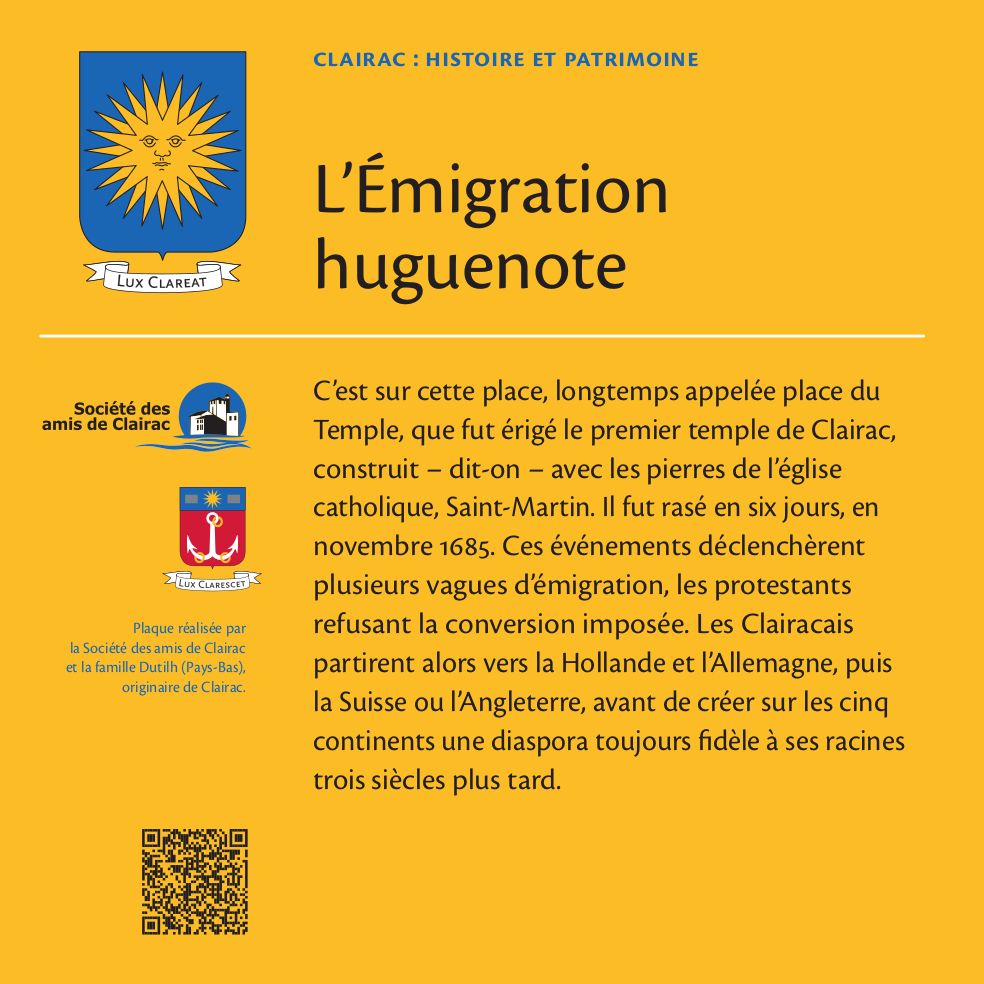
In the three years following the Revocation of the Edict of Nantes a new state policy was implemented. Supported by the arrival of the dragoons of Marshal de Boufflers, it led to a takeover of the city by the Church and triggered a wave of demolitions, expulsions, sales and mass departures for emigration.
Although years have passed since the siege of 1621 and the capture of the town by the armies of King Louis XIII, Clairac has not forgotten that it is almost entirely Protestant despite its abbey being under Roman guardianship, and that the Revocation poses a problem of conscience for everyone: to keep their faith, to convert or to leave?
Keeping your faith in the open: impossible, on pain of sequestration of your property and punishment.
To convert: but how to abandon a belief for which we have fought for sometimes 150 years?
Leaving: the property of the emigrant would then pass to the crown.
From now on, what will characterise the Huguenot emigration of Clairacaise is taking shape: part of the family leaves France for the Netherlands, Germany or England in order to preserve the pride of their faith, while some convert for the sake of it and remain in the country to keep and exploit the goods, this separation favouring the development of international trade.